
 Back to the arcade
 60-second rounds · 3 min read
 Play Code Breaker
What is Code Breaker?
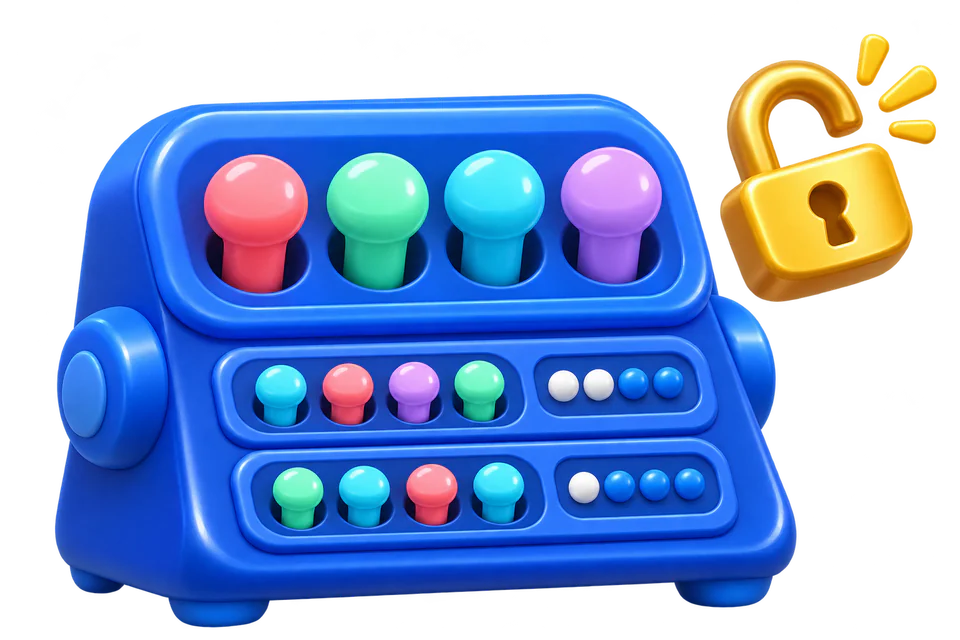
Code Breaker is deduction under a clock. A hidden code must be inferred from feedback on your guesses. Each guess is useful when it narrows the remaining possibilities, even if it does not immediately solve the code.
Keep exact-position information separate from information that a digit belongs elsewhere. Combining those two clue types too early can make a valid observation look contradictory.
Rules and controls
- Choose distinct digits for a complete guess and submit it; a digit cannot repeat within one guess.
- Read the aggregate exact-position and misplaced-digit counts before changing several positions.
- Use controlled follow-up guesses to infer which positions and digits the clues describe.
- You have six guesses for a code. A solution or exhausted guess limit advances to another code after its transition delay.
Use the digit controls to construct a guess, then activate the submit button. Follow the displayed controls for the current code length.
Scoring and rewards
Solved codes are the credited objectives. Unsuccessful deduction guesses are expected and do not receive a separate reward-precision penalty. The benchmark includes several reasoning guesses per code instead of comparing a solution with a simple reaction tap.
Points and XP scale with objective performance, precision, and round length. At full reward performance, a 60-second round earns up to 40 base points and 60 XP. Each level gained adds a 0.1% point bonus. Guest practice has no reward balance.
For eligible rewarded rounds, points remain pending until the sponsored claim’s 12 seconds of focused time and fresh hCaptcha are complete. No ad click or purchase is required.
How difficulty changes
Higher daily difficulty can increase code length and the reasoning required. More positions create more possibilities, so recording what a clue rules out becomes increasingly useful.
Difficulty increases after every three starts of this game during a UTC day, up to level 10, and resets at 00:00 UTC. Your player level and its point bonus are separate from the game’s daily difficulty.
Strategy
Build a repeatable approach
Change a guess deliberately. If every position changes at once, the next clue may be difficult to connect with the previous one.
Improve your next attempt
Use repeated information to test a clear hypothesis, such as whether a known digit belongs in another position. Avoid resubmitting a guess whose consequences are already known.
A worked round
- A first clue reports one exact match and one misplaced digit, without identifying either digit.
- Use controlled follow-up guesses to determine which position creates the exact match.
- Only after a position is established should you preserve it and test placements for the other candidates.
Common mistakes
- Treating a correct digit as automatically being in the correct position.
- Changing confirmed information without a reason.
- Repeating guesses that add no new information before the clock expires.
Questions
Which controls should I use?
Use the digit controls to construct a guess, then activate the submit button. Follow the displayed controls for the current code length.
How should I interpret my result?
The score summarizes this game’s objectives and mistakes. Reward performance is calculated against this game’s own objective benchmark, then scaled by round length. Review the base points and level bonus on your claim receipt.