
 Back to the arcade
 45-second rounds · 4 min read
 Play Dodge Grid
What is Dodge Grid?
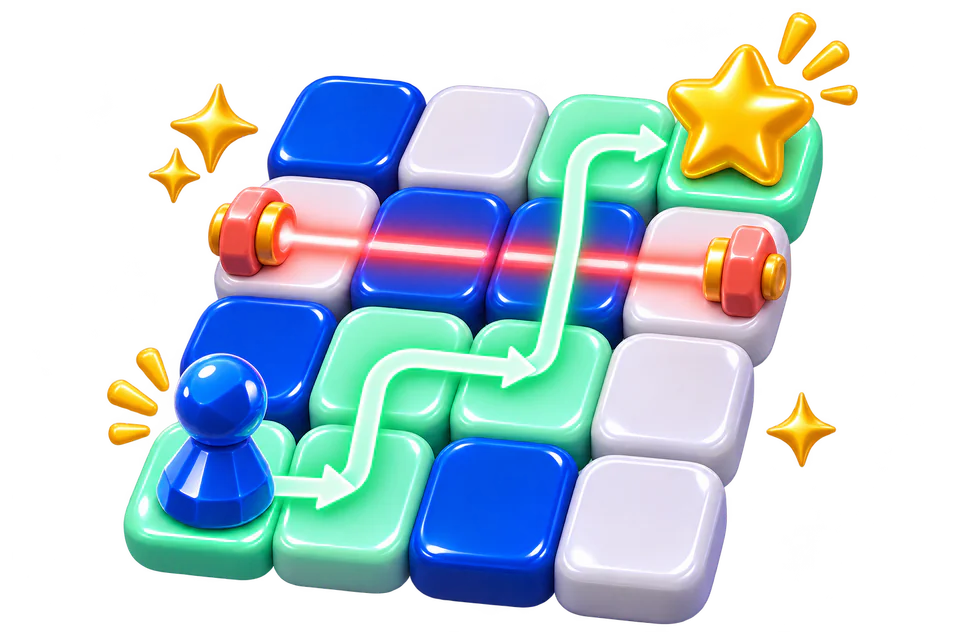
A small rover hunts sparks in a five-by-five arena while a hazard band changes rows and columns. The target spark stays visible, but a direct route can become dangerous when the next band activates. Move deliberately and use safe cells to approach from another side.
Dodge Grid is a 45-second game built around spark pickups reached without entering the active hazard band. The round keeps running after an error, so use the next opportunity to recover. Your best improvement comes from learning the board rather than pressing the controls faster.
Rules and controls
- Move one cell with the arrow keys or direction pads. Enter the gold spark square to collect it. The coral band marks cells that are currently unsafe, and the next cycle changes which row or column is blocked.
- A hazard can appear under a stationary rover at a cycle boundary, so keep the cycle indicator in view. Collisions reset the rover near the center. A collected spark moves to a new free square, requiring another actual route and input.
- Controls are available on the game board as well as the listed keyboard shortcuts. Keyboard controls apply while the game stage is focused; they do not take over account forms or page navigation. During the countdown, watch the starting position and prepare your first move.
Use the controls displayed above the playfield. Touch buttons and keyboard shortcuts are shown before the round begins.
Scoring and rewards
Each spark reached through a legal move adds one objective and 120 score. Entering a hazard, being caught by a changing band, or leaving the grid records a miss. Empty movement and surviving on a safe cell do not add successful objectives.
The displayed arcade score describes this game, while reward performance uses sparks collected through legal movement against a duration-specific benchmark. Longer rounds have a larger base budget. Mistakes reduce precision, and the level bonus applies afterward. Waiting on a finished opportunity cannot create extra objectives or points.
Points and XP scale with objective performance, precision, and round length. At full reward performance, a 45-second round earns up to 30 base points and 45 XP. Each level gained adds a 0.1% point bonus. Guest practice has no reward balance.
For eligible rewarded rounds, points remain pending until the sponsored claim’s 12 seconds of focused time and fresh hCaptcha are complete. No ad click or purchase is required.
How difficulty changes
At higher difficulty the hazard cycle shortens. The grid and movement controls stay consistent, but there is less time to complete a route before the safe corridors change.
Difficulty rises with repeated daily attempts, then follows the daily reset. A later difficulty changes the challenge rather than extending the timer. Read the live board again when the pace changes; a memorized button rhythm can stop matching the next opportunity.
Difficulty increases after every three starts of this game during a UTC day, up to level 10, and resets at 00:00 UTC. Your player level and its point bonus are separate from the game’s daily difficulty.
Strategy
Read before acting
Look at the spark and the hazard together before choosing a direction. A one-square detour can preserve precision when the shortest route crosses the active band.
Recover deliberately
After a reset, read the current band rather than using the move you were about to make before the collision. The board’s timing has continued.
A worked Dodge Grid sequence
- A spark is on the right, but the active band blocks its row. Move through a neighboring safe row first.
- When the band changes to a different column, approach the spark from above and enter its square.
- The next spark appears elsewhere. Plan a new short route that avoids the newly active band.
Common mistakes
- Moving straight toward the spark without checking the coral cells can trade an easy pickup for a collision.
- Remaining in one safe location indefinitely can still fail when the next hazard band crosses that square.
Questions
What exactly counts as a successful objective?
A spark counts when the rover legally enters its square while that landing is safe. The spark’s presence does not cancel a hazard.
What should I do after a mistake?
The rover resets, but the hazard clock continues. Find a safe first step from the new position and build another route to the visible spark.
Can I earn a full result by leaving the game open?
No. Dodge Grid credits only spark pickups reached without entering the active hazard band produced by fresh, valid inputs. An idle board may continue its animation, but it does not complete those objectives for you. Practice is available without an account; reward points require signed-in rewarded play and the claim checks.