
 Back to the arcade
 45-second rounds · 3 min read
 Play Lights Out
What is Lights Out?
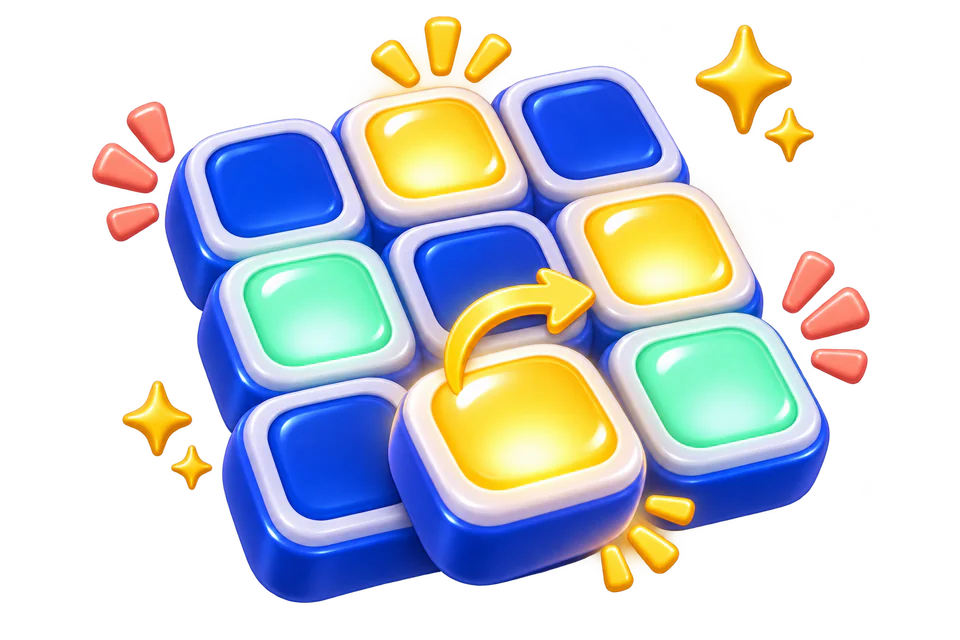
Nine lights form a small switching puzzle. A switch changes more than its own square: it flips the selected light and the lights directly above, below, left, and right. Your objective is to make the entire board dark. Every starting pattern is created by legal switches from darkness, so it is always reversible.
Rules and controls
- Tap any of the nine squares to apply its cross-shaped switch. Lit squares turn off and dark squares turn on. Corners affect three cells, edge centers affect four, and the middle affects five. A completely dark board automatically completes one objective and reveals another pattern. Individual switches earn no objectives, and legal exploratory switches do not count as mistakes.
- Controls respond only during active play. The countdown and the brief change between boards are pauses, not opportunities to submit the next answer early. Touch controls and native Tab/Enter button activation follow the same replay rules.
Use the controls displayed above the playfield. Touch buttons and keyboard shortcuts are shown before the round begins.
Scoring and rewards
The game scoreboard gives 100 for each correct darkened boards objective and subtracts 25 for a recorded mistake, with a minimum displayed score of zero. Only new, accepted objectives count; waiting or repeating completed work does not create achievements.
Reward points use verified performance against this game’s reference pace rather than its raw scoreboard. The reference is: Plan the crossing effects, then use about 600 milliseconds per required switch. Full reference performance corresponds to 40 base reward points and 60 XP per minute; the account’s level bonus is applied separately.
Points and XP scale with objective performance, precision, and round length. At full reward performance, a 45-second round earns up to 30 base points and 45 XP. Each level gained adds a 0.1% point bonus. Guest practice has no reward balance.
For eligible rewarded rounds, points remain pending until the sponsored claim’s 12 seconds of focused time and fresh hCaptcha are complete. No ad click or purchase is required.
How difficulty changes
Higher difficulty uses a greater number of seeded switches to generate the opening pattern. This generally creates more interacting lights, although some effects can cancel. The board remains three-by-three. You may solve it with any valid switch sequence; you are not required to reproduce the generator’s particular sequence.
Difficulty increases after every three starts of this game during a UTC day, up to level 10, and resets at 00:00 UTC. Your player level and its point bonus are separate from the game’s daily difficulty.
Strategy
Plan the next move
Track parity rather than the order of operations. Pressing the same switch twice restores the prior pattern, and switches commute, so repeating a long sequence in a different order is not a new strategy.
Check before committing
Observe which cells a switch can change. To fix a troublesome corner, consider its own switch and the two neighboring edge switches. Thinking about that small neighborhood is more useful than tapping unrelated corners.
A worked example
- Suppose the only lit cells form the cross produced by the center switch.
- Tap the center once. Its own square and four orthogonal neighbors flip.
- All five lights go dark together, completing the board; tapping that center twice instead would undo the solution.
Common mistakes
- Diagonal neighbors never flip merely because they touch a corner of the chosen square.
- Turning off one light can turn on another. Evaluate the whole cross instead of treating squares independently.
Questions
Is there a Check button?
No. Darkness is detected after every switch, so a solved board completes immediately.
Will repeated switching create points?
No. Only an entirely solved board creates an objective. Repeating a switch merely changes the current pattern.