
 Back to the arcade
 45-second rounds · 3 min read
 Play Scale Balance
What is Scale Balance?
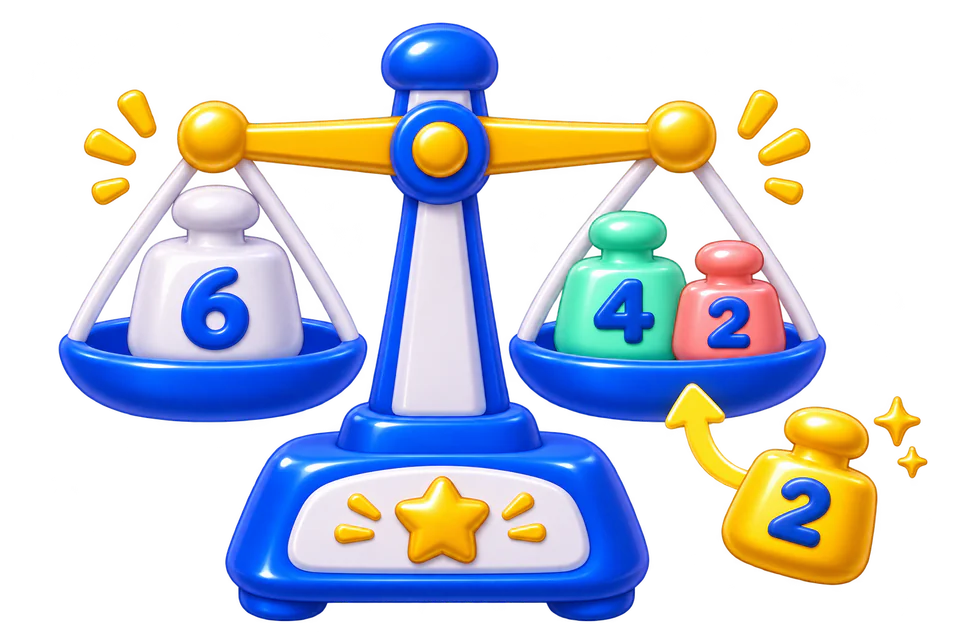
A target mass sits on one pan of a scale. Select a combination of available weights for the other pan and bring the two totals into exact balance. The beam provides a visual comparison, while the printed totals let you calculate precisely. Each weight is a separate object that can be included or excluded once.
Rules and controls
- Tap a weight to put it on the working pan, or tap it again to remove it. Use at least two weights. When the chosen total equals the target, press Check balance to complete one objective. An incorrect check records a mistake and leaves the current combination available for adjustment. Clear weights removes every working weight without changing the target or starting a new puzzle.
- Controls respond only during active play. The countdown and the brief change between boards are pauses, not opportunities to submit the next answer early. Touch controls and native Tab/Enter button activation follow the same replay rules.
Use the controls displayed above the playfield. Touch buttons and keyboard shortcuts are shown before the round begins.
Scoring and rewards
The game scoreboard gives 100 for each correct balanced scales objective and subtracts 25 for a recorded mistake, with a minimum displayed score of zero. Only new, accepted objectives count; waiting or repeating completed work does not create achievements.
Reward points use verified performance against this game’s reference pace rather than its raw scoreboard. The reference is: Read the target and plan an exact combination of available weights. Full reference performance corresponds to 40 base reward points and 60 XP per minute; the account’s level bonus is applied separately.
Points and XP scale with objective performance, precision, and round length. At full reward performance, a 45-second round earns up to 30 base points and 45 XP. Each level gained adds a 0.1% point bonus. Guest practice has no reward balance.
For eligible rewarded rounds, points remain pending until the sponsored claim’s 12 seconds of focused time and fresh hCaptcha are complete. No ad click or purchase is required.
How difficulty changes
Higher difficulty expands the pool of possible weight values and may require a larger starting combination. Every target is constructed from the available weights, so at least one valid solution exists. You may use a different combination with the same total. The scale is an exact integer puzzle rather than a test of estimating a painted beam angle.
Difficulty increases after every three starts of this game during a UTC day, up to level 10, and resets at 00:00 UTC. Your player level and its point bonus are separate from the game’s daily difficulty.
Strategy
Plan the next move
Find the difference between the target and the working pan. If you are too heavy by three units, look for a selected weight of three or a replacement that reduces the total by exactly three.
Check before committing
Keep an eye on the number of selected weights. A single available weight might equal the target, but the rules require a combination of at least two. Plan an accepted combination before checking.
A worked example
- The target mass is 12 units and available weights include 2, 4, and 6.
- Select those three weights to place 12 units on the working pan.
- The beam becomes level, but the objective is committed only after you press Check balance.
Common mistakes
- The same weight cannot be used twice; clicking it again removes it.
- A nearly level-looking beam is not a substitute for an exact numeric total.
Questions
Are different exact combinations accepted?
Yes. The game checks the mass and the minimum of two weights, not a single hidden preferred combination.
Does clearing a combination count as a mistake?
No. You may explore and revise freely. A mistake is recorded only when an incorrect combination is checked.