
 Back to the arcade
 60-second rounds · 4 min read
 Play Stack Tower
What is Stack Tower?
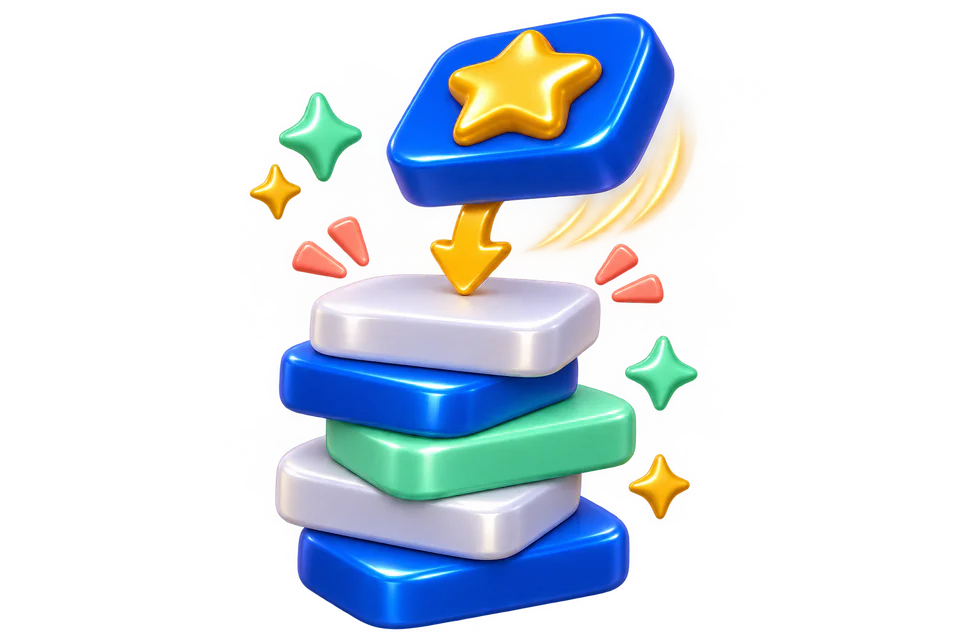
A moving slab sweeps above a tiny foundation. Drop it when it overlaps the tower, and only the supported part remains. A small error makes the next landing narrower, turning a simple timing challenge into a test of recovery and alignment.
Stack Tower is a 60-second game built around supported block placements on the tower. The round keeps running after an error, so use the next opportunity to recover. Your best improvement comes from learning the board rather than pressing the controls faster.
Rules and controls
- Tap Drop or press Space to release the current slab. Its horizontal position at that instant determines the overlap with the top block. You get one drop for each moving slab; the next slab arrives on the regular round schedule.
- The moving slab has the same width as the current tower top. Its bright support guide shows the target beneath it. A failed drop rebuilds a fresh foundation so you can continue; ignoring an entire slab also loses that opportunity.
- Controls are available on the game board as well as the listed keyboard shortcuts. Keyboard controls apply while the game stage is focused; they do not take over account forms or page navigation. During the countdown, watch the starting position and prepare your first move.
Use the controls displayed above the playfield. Touch buttons and keyboard shortcuts are shown before the round begins.
Scoring and rewards
A drop with sufficient supported overlap adds one placement and 120 score. The overlapping width becomes the new tower width. A completely unsupported or extremely narrow overlap is a miss and restarts the foundation, while earlier placements stay in the result.
The displayed arcade score describes this game, while reward performance uses overlapping blocks placed against a duration-specific benchmark. Longer rounds have a larger base budget. Mistakes reduce precision, and the level bonus applies afterward. Waiting on a finished opportunity cannot create extra objectives or points.
Points and XP scale with objective performance, precision, and round length. At full reward performance, a 60-second round earns up to 40 base points and 60 XP. Each level gained adds a 0.1% point bonus. Guest practice has no reward balance.
For eligible rewarded rounds, points remain pending until the sponsored claim’s 12 seconds of focused time and fresh hCaptcha are complete. No ad click or purchase is required.
How difficulty changes
Higher difficulties increase the slab’s sweep speed, begin with a narrower foundation, and shorten the time available for each placement. The motion phase varies between slabs, so a fixed delay is unreliable.
Difficulty rises with repeated daily attempts, then follows the daily reset. A later difficulty changes the challenge rather than extending the timer. Read the live board again when the pace changes; a memorized button rhythm can stop matching the next opportunity.
Difficulty increases after every three starts of this game during a UTC day, up to level 10, and resets at 00:00 UTC. Your player level and its point bonus are separate from the game’s daily difficulty.
Strategy
Read before acting
Compare the slab’s edges with the support edges instead of staring at its center alone. A nearly centered placement preserves room for the following drop.
Recover deliberately
When the tower narrows, prioritize a safe overlap rather than a perfect-looking drop. After a reset, use the wider foundation to establish control again.
A worked Stack Tower sequence
- The slab moves left to right over a centered foundation. You wait until its edges almost align with the support.
- Press Drop. A small overhang is trimmed, and the supported section becomes the new top block.
- The next slab is slightly narrower. Drop near its center crossing to preserve the width you have left.
Common mistakes
- Repeatedly dropping on the same side steadily erodes the tower, even when every individual placement initially succeeds.
- A perfect-looking visual rhythm from one slab can fail on the next because the seeded motion phase changes.
Questions
What exactly counts as a successful objective?
A placement counts only when enough of the released slab overlaps the existing support. The surviving overlap controls the next slab’s width.
What should I do after a mistake?
An unsupported drop creates a fresh foundation. Earlier successful placements remain, so take the next block calmly instead of rushing to recover height.
Can I earn a full result by leaving the game open?
No. Stack Tower credits only supported block placements on the tower produced by fresh, valid inputs. An idle board may continue its animation, but it does not complete those objectives for you. Practice is available without an account; reward points require signed-in rewarded play and the claim checks.