
 Back to the arcade
 60-second rounds · 3 min read
 Play Tile Slide
What is Tile Slide?
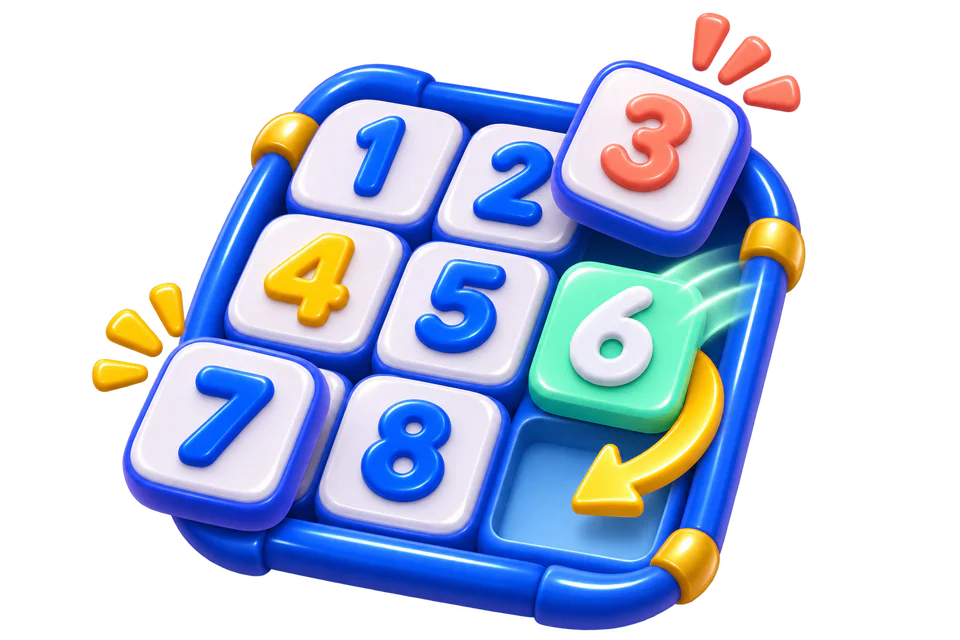
Restore a three-by-three sliding puzzle to ascending order. Eight numbered tiles surround one empty space, and only a tile touching that space along an edge can move. The board begins as a legal scramble of the solved layout, which guarantees it can be restored without lifting tiles or swapping arbitrary positions.
Rules and controls
- Tap a tile adjacent to the empty square to slide it into that square. Your goal is 1, 2, 3 across the top; 4, 5, 6 across the middle; and 7, 8, empty across the bottom. Completing that layout earns one objective and creates a fresh scramble. Invalid nonadjacent selections record mistakes. Legal moves, including moves that temporarily undo progress, do not count as mistakes.
- Controls respond only during active play. The countdown and the brief change between boards are pauses, not opportunities to submit the next answer early. Touch controls and native Tab/Enter button activation follow the same replay rules.
Use the controls displayed above the playfield. Touch buttons and keyboard shortcuts are shown before the round begins.
Scoring and rewards
The game scoreboard gives 100 for each correct restored sliding boards objective and subtracts 25 for a recorded mistake, with a minimum displayed score of zero. Only new, accepted objectives count; waiting or repeating completed work does not create achievements.
Reward points use verified performance against this game’s reference pace rather than its raw scoreboard. The reference is: 550 milliseconds per scramble move, plus inspection and transition. Full reference performance corresponds to 40 base reward points and 60 XP per minute; the account’s level bonus is applied separately.
Points and XP scale with objective performance, precision, and round length. At full reward performance, a 60-second round earns up to 40 base points and 60 XP. Each level gained adds a 0.1% point bonus. Guest practice has no reward balance.
For eligible rewarded rounds, points remain pending until the sponsored claim’s 12 seconds of focused time and fresh hCaptcha are complete. No ad click or purchase is required.
How difficulty changes
Later daily difficulty performs more scramble moves before showing the board. The grid stays three-by-three, preserving readable tile sizes on phones. The reference pace allows planning and movement; raw move count alone does not earn achievements, so repeatedly sliding a tile back and forth provides no reward.
Difficulty increases after every three starts of this game during a UTC day, up to level 10, and resets at 00:00 UTC. Your player level and its point bonus are separate from the game’s daily difficulty.
Strategy
Plan the next move
Place the first row before concentrating on the lower rows. Preserve useful tile relationships, and remember that moving a correct tile temporarily can create the space needed to complete a larger arrangement.
Check before committing
Think in short cycles around a two-by-two corner. Sliding three or four neighboring tiles can reposition one desired tile while bringing the empty space back to a useful location.
A worked example
- If the final row is 7, empty, 8 and every earlier row is correct, tap tile 8.
- It moves left into the empty square.
- The bottom-right square becomes empty, producing the required final layout and completing the board.
Common mistakes
- Diagonal tiles cannot slide into the empty space.
- Do not chase the empty square randomly; choose the tile you want to improve and plan how the empty space will reach it.
Questions
Can a generated board be impossible?
No. Each board is scrambled by legal moves from the solved state. Reversing those moves always provides a solution.
Are extra legal moves penalized?
They consume time but are not mistakes. The objective is a completed board, not a particular shortest sequence.