
 Back to the arcade
 60-second rounds · 4 min read
 Play Pair Parade
What is Pair Parade?
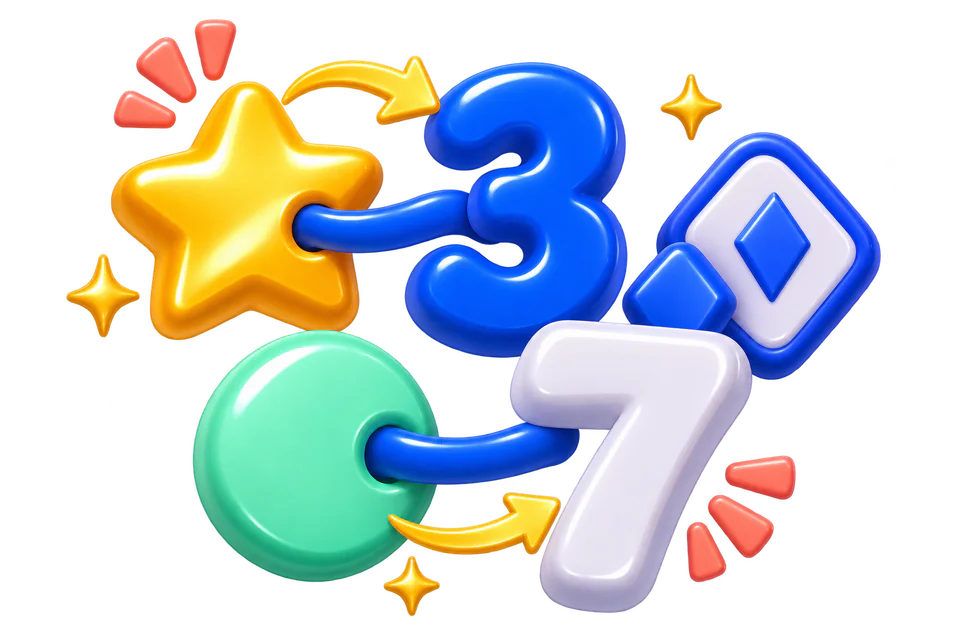
A small table pairs distinct symbols with distinct numbers. After the table disappears, one of its symbols is queried. Choose the number that was paired with that symbol. This tests associative binding rather than simple familiarity: all answer numbers appeared somewhere in the table, but only one belongs to the queried symbol.
Pair Parade is a 60-second round-based game. Each short challenge has its own scheduled preview and answer window. The next challenge arrives on the game clock, so taking an answer early does not create extra rounds. Practice is useful for learning the transition from observing to responding before trying to build a consistent result.
Rules and controls
- Read each row as one symbol-number association. Symbols and numbers are unique within the preview.
- When the table is hidden, use the queried symbol to retrieve its partner and choose one answer.
- Use the visible buttons on a phone or a desktop. Numbered answer choices also accept their displayed number keys; Digit Span uses the actual digit keys, and Timekeeper accepts Space. Controls activate only during the answer phase. A selection is final for that objective, and another tap cannot overwrite it.
Use the controls displayed above the playfield. Touch buttons and keyboard shortcuts are shown before the round begins.
Scoring and rewards
A correct objective adds 100 game-score points. An incorrect or unanswered objective counts as a miss and subtracts 25 before the final game score is floored at zero. In Digit Span each digit position is scored separately; the other games in this set accept one answer per challenge.
Reward performance uses associations recalled, the number of available objectives, and precision. Raw display score is not a direct reward conversion. Completing more valid objectives helps, while repeated wrong inputs cannot substitute for accurate play. Longer completed games have a proportionate reward allowance, and guest practice does not award account points or XP.
Points and XP scale with objective performance, precision, and round length. At full reward performance, a 60-second round earns up to 40 base points and 60 XP. Each level gained adds a 0.1% point bonus. Guest practice has no reward balance.
For eligible rewarded rounds, points remain pending until the sponsored claim’s 12 seconds of focused time and fresh hCaptcha are complete. No ad click or purchase is required.
How difficulty changes
The table increases from three to five associations. Viewing time grows modestly with table size, while recall must happen in a shorter answer window.
Difficulty increases with repeated play during the day. Read the current instruction rather than assuming a familiar pace: a shorter preview or answer window can change how much information you should process at once. The fundamental objective remains the same, and every answer is checked against the actual challenge shown.
Difficulty increases after every three starts of this game during a UTC day, up to level 10, and resets at 00:00 UTC. Your player level and its point bonus are separate from the game’s daily difficulty.
Strategy
Build a reliable method
Turn each pair into a tiny image, such as three stars or a circle containing seven. Keep pairs intact rather than memorizing separate lists of symbols and numbers.
Protect the transition
Use the preview to finish observing, then switch attention to the response. Keep your finger or pointer near the answer area without pressing early. If one challenge is lost, let it end and begin the next with a fresh plan instead of carrying a guessed answer forward.
A worked challenge
- The preview pairs circle with 7, star with 3, and diamond with 5.
- Remember the short phrases “circle seven,” “star three,” and “diamond five.”
- The answer prompt asks for the partner of the star.
- Choose 3, even though 7 and 5 also appeared in the preview.
Common mistakes
- Recognizing a familiar number without checking which symbol originally accompanied it.
- Rushing through a rule badge, holding a key across transitions, or assuming that repeated clicks provide additional chances. Each scheduled objective has a limited number of final responses.
Questions
Can I change an answer after selecting it?
No. Each objective accepts one final answer. Digit Span advances to a new position after every digit, so a later digit is a new response rather than a correction.
Does answering faster create more reward opportunities?
No. Challenges follow the scheduled game clock. Accuracy and completing available objectives matter; an early correct answer does not shorten the round or generate extra challenges.
What if I do nothing during an answer window?
When that window expires, its unanswered objective becomes a miss. Simply leaving the game open creates no hits, no successful objectives, and no participation reward.